

7 Steps to Managing Board Compliance for Government Agencies
Last Updated: November 7, 2026
Quick Summary
Managing board compliance for government agencies means separating board oversight from management delivery, then linking every obligation to a law, an owner and a control in a single register. Keep the board compliance checklist to one page, review the register at least quarterly, and escalate breaches using thresholds set in advance.
- The board approves the compliance framework and monitors results; management builds controls and reports upward.
- Build the framework in three layers: national, jurisdictional and agency.
- Keep the board compliance checklist to one page, because long checklists get ignored.
- Assign a register custodian and review the obligation register at least quarterly.
- Refresh register of interests declarations at least annually and whenever circumstances change.
Table of Contents
- Step 1: Map Government Board Compliance Responsibilities
- Step 2: Build Your Legislative Compliance Framework
- Step 3: Create a Board Compliance Checklist
- Step 4: Establish a Compliance Management System and Obligation Register
- Step 5: Set Up Board Compliance Reporting and Monitoring
- Step 6: Manage Conflicts of Interest and Registers of Interests
- Step 7: Respond to Compliance Breaches and Remediate
- Put Your Board Compliance Framework Into Practice with Athena Board
- Frequently Asked Questions
Step 1: Map Government Board Compliance Responsibilities
Managing board compliance for government agencies starts with one clear split: the board sets direction and oversees, while management delivers and reports. Get that line wrong and every later step wobbles.
A government board compliance responsibility is the specific legal and governance duty assigned to a board or accountable authority, plus the evidence needed to prove it was met.
Distinguishing board oversight from management responsibility
Oversight means the board approves strategy, monitors risk and holds management to account. Management runs programs, spends funds and keeps records. Boards that blur the two end up doing neither well.
- Board: approves the compliance framework and monitors results
- Management: builds controls, collects evidence, reports upward
- Both: escalate breaches and review changed obligations
Legal duties of boards and accountable authority
Accountable authorities carry duties under their enabling legislation, plus public sector governance, financial management and record keeping rules. The exact duties depend on your jurisdiction and Act, so read the enabling legislation directly rather than relying on summaries. The Australian National Audit Office governance guidance sets out the accountability expectations agencies are measured against.
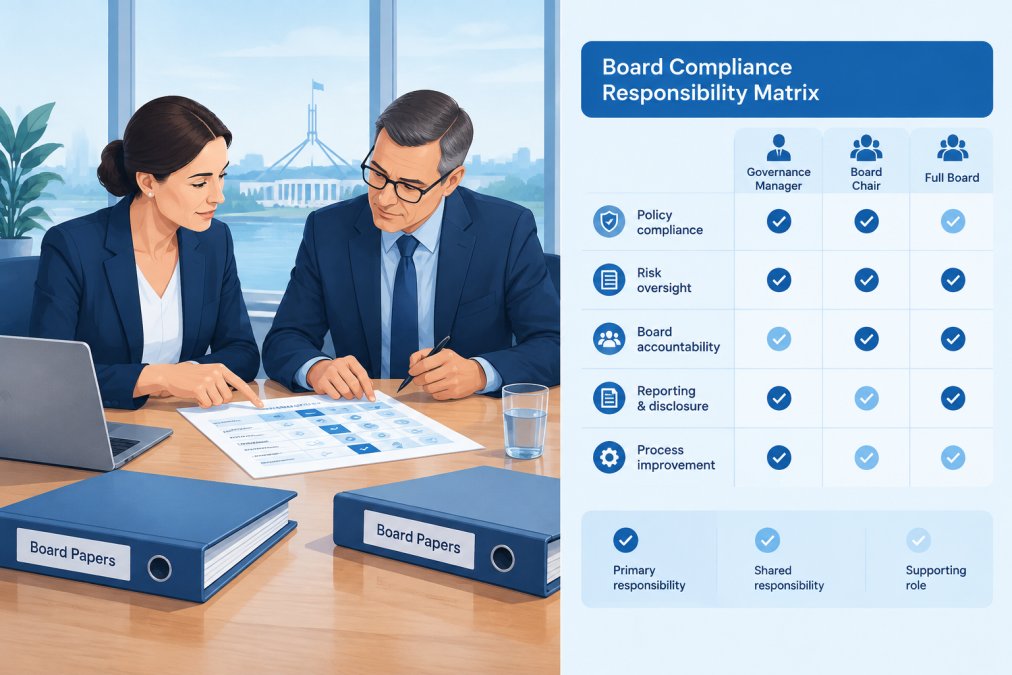
Both are Australian.
Step 2: Build Your Legislative Compliance Framework
A legislative compliance framework is the documented system that links each obligation to a law, an owner and a control.
Start with the enabling legislation
Read the Act and note every duty that lands on the board or accountable authority. Look for reporting deadlines, approval thresholds, record keeping requirements and any power to issue directions.
Layer national requirements over state and territory rules
A common pattern in Australian agencies is that national frameworks set the expectation while state or territory legislation and whole-of-government directions set the specific mechanism. The Australian National Audit Office governance guidance sets out the accountability expectations agencies are measured against, and the public sector governance, financial management and record keeping rules that apply to your jurisdiction sit alongside it. Build the framework in three layers:
- National layer: public sector governance, financial management and record keeping expectations that apply across agencies
- Jurisdictional layer: your enabling Act, associated regulations and any ministerial directions
- Agency layer: internal policies, delegations and board charters that translate the above into local practice
Where the layers conflict, the stricter obligation usually governs in practice, but confirm that against your own legal advice rather than assuming it.
Translate policies and directives into board actions
Policies and ministerial directives usually need translation, not copying. Turn each one into a board-level action with a named owner and a review date. A common mistake is filing the directive without assigning anyone to act on it.
Capture obligations in a single register
Every obligation should be recorded once, with its source, the layer it sits in, the owner, the control that satisfies it, the evidence that proves it and the next review date. Where an obligation appears in more than one layer, record the strictest version and note the overlap.
Watch out: frameworks built only from national guidance tend to miss jurisdictional specifics, and frameworks built only from the enabling Act tend to miss whole-of-government directions, build both layers before declaring the framework complete.
Step 3: Create a Board Compliance Checklist
A board compliance checklist is a short, repeatable list the board works through each meeting to confirm its obligations are being met. Keep it to one page. Long checklists get ignored.
Build it around four questions:
- Which obligations fell due since the last meeting?
- What evidence shows each one was met?
- What changed in legislation or policy?
- What needs escalation now?
Both are Australian.
Step 4: Establish a Compliance Management System and Obligation Register
A compliance management system is the set of processes, roles and records that keeps obligations met over time. The obligation register sits at its centre. Every entry should record the obligation, its source, the owner, the control, the evidence and the review date.
What most guides miss is the maintenance burden. Registers fail because nobody owns the update cycle. Assign a register custodian and review it at least quarterly.
Step 5: Set Up Board Compliance Reporting and Monitoring
Board compliance reporting is the routine flow of evidence to the board showing obligations are met, with exceptions flagged early. Reporting should be short, consistent and tied to the register.
Compliance assurance metrics and dashboards
Track a small set of measures: obligations reviewed on time, open breaches, overdue corrective actions and register currency. Dashboards work best when they show trend, not just a snapshot. For a broader view of the framework these steps sit inside, see our guide on how to manage board compliance in Australia.
| Measure | Frequency | Owner | Red flag |
|---|---|---|---|
| Obligations reviewed on time | Quarterly | Register custodian | Below target two quarters running |
| Open compliance breaches | Monthly | Governance manager | Any breach unassigned |
| Overdue corrective actions | Monthly | Risk lead | Items past due date |
| Register currency | Quarterly | Register custodian | Entries not reviewed in 12 months |
Step 6: Manage Conflicts of Interest and Registers of Interests
A register of interests records declared conflicts so the board can manage them openly. Collect declarations at appointment, then refresh them at least annually and whenever circumstances change.
- Record the interest and its nature
- Decide how it will be managed
- Note who is excluded from which discussions
- Review the register each meeting
For a detailed process, read our step-by-step guide to managing conflict of interest disclosures. You can record and manage declarations in Athena Board’s conflict of interest register, or follow our setup walkthrough to start creating a conflict of interests register in the platform.
Step 7: Respond to Compliance Breaches and Remediate
A compliance breach response should be quick, documented and blameless in tone. The aim is a fix and a control, not a culprit. Most guidance stops at that principle; the operational gap is the escalation logic, the reporting routes and the remediation governance that turn it into something a board can rely on. Clear escalation logic and remediation governance also give the board reporting strategy a practical basis for tracking cyber risks from incident response through to sustained control.
Separate suspected from confirmed breaches
Treat a suspected breach as a trigger for assessment, not a finding. Log it, assign an assessor and set a short assessment window. Only move it to confirmed once the facts are established. This distinction matters because it stops the register filling with unverified entries and keeps the board’s reporting honest.
Set escalation thresholds in advance
The board should agree, before any breach occurs, which categories must reach it and which can be handled by management. A workable pattern is to escalate on any of the following:
- A suspected breach of a statutory duty or a ministerial direction
- A breach with financial, safety or reputational consequences above a threshold the board has set
- Any breach that has not been contained within the assessment window
- Any repeat of a breach already remediated
Thresholds belong in the compliance framework, not in a meeting-by-meeting judgement call.
Follow a documented response sequence
- Log the breach, its date and how it was detected
- Assess impact and notify the right people, including any external regulator where the obligation requires it
- Contain the issue
- Assign corrective action with an owner and due date
- Verify the fix and update the register
- Report the outcome to the board, with the evidence filed in the binder
Govern the remediation, not just the fix
Corrective actions need the same discipline as any other obligation: an owner, a due date, a verification step and a closure record. Track overdue corrective actions as a standing board metric, and review closed items at the next meeting to confirm the fix held. Where the same control fails twice, treat it as a design problem rather than a one-off.
Capture lessons learned
A short post-incident note, what happened, why the control failed, what changed, is the cheapest way to stop repeat breaches. File it alongside the register entry so the audit trail shows not just that the breach was fixed but that the framework improved.
Watch out: breaches left unlogged quietly become repeat breaches, and the audit trail disappears with them.
Put Your Board Compliance Framework Into Practice with Athena Board
The framework above only holds if the evidence survives an audit. That is where a proper board portal earns its place. If you are weighing up platforms, our blueprint of must-have board portal features gives you a checklist to test against your compliance needs.
Most agencies can draft the framework. Fewer can prove it works when an auditor asks for the trail. Athena Board gives your board a single workspace for resolutions, minutes and registers, backed by audit logs and secure document storage, so the evidence is already there. Get started with Athena Board and turn your compliance framework into a record you can defend.
Frequently Asked Questions
What compliance responsibilities do government agency boards have?
Government agency boards are accountable for overseeing legal duties under their enabling legislation, statutory obligations, government policies and directives. This includes financial management, risk management, internal controls and maintaining a register of interests. Boards must also ensure a compliance management system is in place, monitor obligation registers, review compliance reporting and escalate breaches. The board oversees; management implements and reports. Clear separation of these roles is central to effective board compliance and accountability.
What should a board compliance checklist include?
A board compliance checklist should cover obligation identification, register maintenance, meeting agendas with compliance items, conflict of interest declarations, financial and risk reporting, and evidence of monitoring and review. Include periodic reviews of changed obligations, documentation and record keeping requirements, and breach escalation steps. Use the checklist at every meeting cycle so nothing is missed, and update it whenever legislation, policies or directives change. Pair it with an obligation register for a complete view of board compliance.
How often should a board review compliance reports?
Most government agency boards review compliance reports at each scheduled meeting, with a deeper review quarterly or annually depending on risk. High-risk obligations such as financial accountability and statutory reporting may need monthly management updates. The board should set a reporting calendar, require exception reporting for breaches, and track corrective actions to closure. Regular review keeps the legislative compliance framework current and gives the board assurance that controls are working.
What should a board do when a compliance breach is identified?
When a compliance breach is identified, the board should ensure it is documented, escalated to the accountable authority and assessed for severity and legal implications. Management should implement corrective action, and the board should monitor remediation through to closure. Record the incident, the response and the outcome in the obligation register and board minutes. Review whether risk controls need strengthening to prevent recurrence, and report the breach through the appropriate channels in line with government policies and directives.
