
Student Data Security is Now a Board Responsibility: Lessons from the NSW Auditor-General
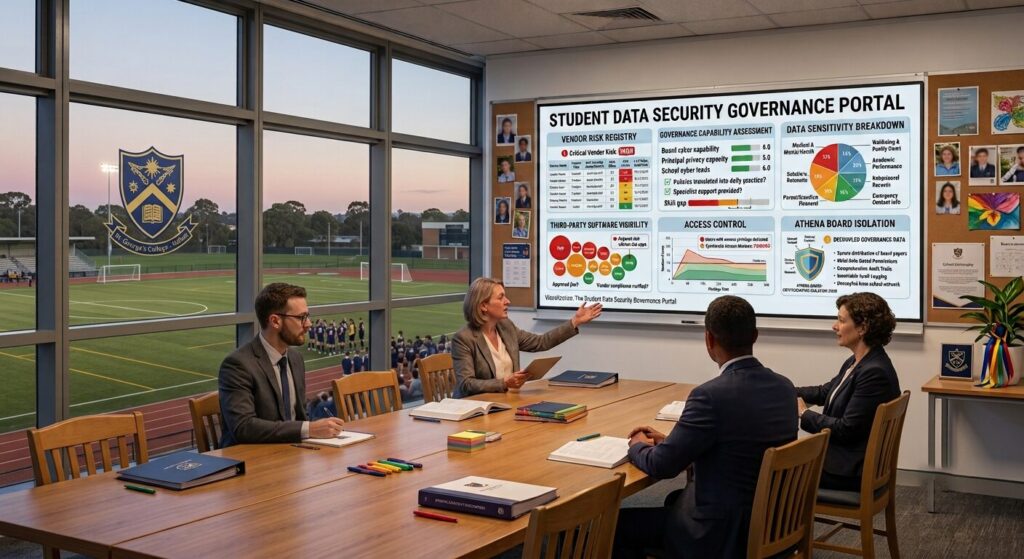
The NSW Auditor-General’s recent report, Security and Privacy of Student Information, carries vital lessons for every school board in Australia, whether operating across the government, Catholic, or independent sectors. Student Data Security is Now a Board Responsibility
Although the audit evaluated NSW public schools, the core governance challenges it uncovered are universal across education. Every school manages high-volume, highly sensitive student data, relies on an expanding array of third-party software providers, and holds an absolute duty of care to ensure that data remains protected.
The report’s central takeaway is unambiguous: protecting student information is no longer a purely operational IT responsibility, it is a fundamental board obligation.
Governance Was Identified as the Greatest Weakness
The audit revealed that while high-level cyber security policies and technical controls were in place, implementation crumbled at the practical, operational level.
As the Auditor-General observed:
“There are critical gaps in the translation of departmental policies, systems and supports into day-to-day practice within schools.”
Crucially, the responsibility for navigating increasingly complex privacy and cyber security risks had been handed directly to school principals, without verifying whether they possessed the specialised technical capability or operational bandwidth to manage them.
“The department allocates responsibility for managing the security and privacy of student information to school principals, without assessing their capability and capacity to meet these obligations.”
For independent school boards and governors, the lesson is immediate. Effective governance demands that boards receive active, verifiable assurance that security controls exist and function properly, rather than relying on comfortable assumptions.
Access Controls Demand Board-Level Oversight
Access management emerged as one of the audit’s most critical findings. Inconsistent practices meant former staff retained system access after changing roles, while active staff routinely accessed far more information than required for their specific duties.
“These controls do not consistently ensure that access to student information is only available to staff who need it to perform their role.”
This risk applies directly to governance workflows. Confidential board packs contain sensitive student wellbeing files, executive remuneration details, and strategic master plans. Boards must guarantee that board papers and sub-committee records are strictly restricted to authorised individuals through automated, role-based access, supported by regular access audits.
The Hidden Risk of Third-Party Software
Modern educational institutions rely on dozens—sometimes hundreds—of third-party software applications for learning management, parent communication, and administration.
The Auditor-General highlighted a troubling lack of visibility regarding unapproved software used across schools, noting that even officially approved vendors were rarely subjected to ongoing, independent compliance checks.
Every school board must maintain clear oversight over four critical vendor questions:
1. VENDOR MAPPING – Which third-party applications hold data?
2. DATA SOVEREIGNTY – Where is the student data hosted?
3. COMPLIANCE AUDITS – Are vendors independently verified annually?
4. ONGOING MONITORING – How are third-party risks actively tracked?
Policies Do Not Equal Real Assurance
A key theme of the report is the dangerous gap between policy creation and operational reality. Having a written cyber security policy on file offers zero protection during an active breach.
“The department’s systematic assurance activities… do not include student information management.”
Boards must move past passive compliance. Demonstrating duty of care requires tangible evidence that security policies are enforced—backed by immutable audit logs, real-time tracking, and structured reporting.
Elevating Governance in the Boardroom
Student records contain some of the most sensitive personal data an organisation can manage—including confidential medical files, psychological assessments, family court parenting orders, behavioural records, and family financial details.
Protecting this information requires an architectural approach to security. This is precisely why forward-thinking school boards are adopting purpose-built governance platforms like Athena Board:
- Zero-Trust Architecture: Built from the ground up on Zero-Trust principles, Athena Board ensures that confidential documents are cryptographically isolated, ensuring unauthorised internal or external parties cannot inspect sensitive board papers.
- Strict Role-Based Permissions: Prevents over-privileged access by ensuring directors and committee members only view materials explicit to their designated governance scope.
- Granular Audit Trails: Maintains unalterable records of every document view, download, and permission change, providing boards with the exact compliance assurance demanded by regulatory bodies.
- Secure Sovereign Storage: Eliminates the vulnerability of distributing sensitive student welfare attachments over unencrypted email or unsecured PDF downloads.
As regulatory oversight tightens and cyber threats grow more sophisticated, boards that proactively strengthen their governance architecture today will be far better positioned to protect their institutions, safeguard their reputations, and honour the trust placed in them by parents and students.
Athena Board can help, contact us at sales@athenaboard.com.